
Could a taxi be the more practical choice, even when Winchester has a train connection? The question “taxi instead of train Winchester” is about more than the time shown on a timetable. A train may suit a direct route, whilst a taxi can take you from your pickup point to your destination without a separate journey to or from the station.
It’s understandable to focus on travel time, but the full journey also includes connections, waiting, luggage and how many people are travelling. Comparing these details can change which option works best for your plans.
This guide compares taxis and trains for Winchester journeys by convenience, access, timing and overall travel needs. You’ll learn what to weigh up, including the route at each end and the possibility of delays or missed connections, so you can choose based on the whole trip rather than one leg alone. It also explains when a local taxi, including for a long-distance journey, could simplify your arrangements.
Key Takeaways
- For a taxi instead of train Winchester journey, compare the route from your actual starting point to your final destination, not just station-to-station travel.
- Check the train timetable and service updates, then account for connections and the onward leg before deciding.
- Consider how passenger numbers, luggage and mobility needs affect each option, especially when the journey involves several stages.
- Use a simple checklist to weigh schedule dependence, road traffic and the practical needs of everyone travelling.
- When a direct pickup and drop-off better suit your plans, Royal Winchester Cars provides local and long-distance taxi journeys.
Taxi or train in Winchester: what are you comparing?
A taxi follows a journey planned around your pickup and destination; a train follows rail routes and published timetables. That difference is the starting point, not the whole decision. A taxi instead of train Winchester comparison should include how you reach the departure point, what happens at the other end and whether the route works for your schedule and passenger needs.
A door-to-door taxi journey means travelling by road between an agreed pickup point and a chosen drop-off point. A station-based train journey means getting to a railway station, travelling along the rail network and continuing from the arrival station to your final destination. The complete trip includes every leg, not just the central part of the journey.
This matters in a city such as Winchester, England, where your plans may begin or end away from a railway station. A train may align neatly with both ends of a journey; in another case, reaching the station and arranging onward travel may add extra stages. Neither mode is automatically faster or more dependable. The suitable option depends on the route, timing, live travel conditions and what the people travelling need.
What does door-to-door travel mean in Winchester?
A taxi can collect you at an agreed Winchester pickup point and take you to your chosen destination, subject to the road route and access at each end. A train journey requires you to reach Winchester Railway Station first, then travel from the destination station to your final address or appointment. That last leg can change the overall practicality of either option, especially if it involves extra arrangements or waiting.
Picture a trip that starts at home and ends at a venue away from the station. Compare the full taxi route with the walk, lift or other transport needed to reach the platform, plus the onward journey after arrival. If a train station is close to both endpoints, those extra stages may be limited. If not, include them in your plan rather than treating them as incidental.
When can a train be the more practical choice?
Rail can suit a journey when stations are well placed for your start and destination and the available service matches your plans. Review the timetable for your intended travel time and check whether the route requires a change between services. Allow for the time and coordination involved in changing trains, then include travel to and from the stations when comparing the complete trip.
Live conditions matter too. Road traffic can affect a taxi journey, whilst service changes or disruption can alter a rail plan. Check current travel information close to departure and consider how much flexibility you need at either end. The useful question isn’t which mode wins in general; it’s which journey has fewer inconvenient stages for your specific route, timing and requirements.
Compare the full journey: pickup, connections and final destination
A useful comparison records every stage from your starting point to your final address. A train’s advertised journey time covers the rail part, not necessarily the trip to the station, waiting before departure or onward travel after arrival. A taxi estimate concerns road travel between pickup and drop-off, with traffic affecting the journey.
Compare total door-to-door time, not only time aboard a train. For a taxi instead of train Winchester trip, lay out the stages side by side before deciding:
Starting point: A taxi can collect you at an agreed address or pickup point. For rail, include the time and transport needed to reach the station.
Route: A taxi travels by road between the agreed points. A train follows the available rail route, which may not serve your exact destination.
Changes: A taxi journey may be direct, depending on the planned route. A train itinerary may involve changing services, so include the connection and time between trains.
Final leg: A taxi can take you to the chosen drop-off point. From a destination station, you may need to walk or arrange onward transport.
Schedule dependence: A taxi journey is affected by road conditions and its pickup arrangement. Rail travel depends on departure times and service information.
How do pickup points and connections change the decision?
Start with your actual address in Winchester, not a general map point. If you take the train, account for getting to Winchester Railway Station and allow time before departure. At the other end, identify the arrival station and how you’ll reach your final address. Check current timetables and service updates before setting out, particularly if your plan includes a connection.
These extra stages can affect the practical choice. A station close to your destination may make the onward leg straightforward. If it’s farther away, that leg becomes part of the rail option’s overall time and arrangements. A taxi may reduce separate access legs when both pickup and destination suit road travel, though traffic and the road route still matter.
How should you compare time without guessing?
Keep the time components separate. For rail, note station access, waiting, time on the train, any connection and the final leg. For a taxi, consider the road journey and any time needed to meet the vehicle at the agreed pickup point. Use current, route-specific travel information rather than assuming one mode will take a set amount of time.
Road traffic and rail disruption affect plans in different ways. Check live conditions close to departure and consider whether a delay would affect an appointment or connection. UK transport statistics offer wider context on transport in Great Britain, but they can’t predict conditions for your individual trip. If a direct road journey fits your endpoints, Royal Winchester Cars offers local and long-distance taxi journeys to consider alongside your train itinerary.
When is a Winchester taxi a better fit than the train?
A taxi may suit your trip when its pickup and drop-off points match your plans and it reduces the number of separate stages. That can matter if you’re travelling with several people, carrying luggage or need to start from a specific address. It doesn’t mean a taxi is always quicker, cheaper or more accessible. Compare the practical arrangements for everyone travelling, then weigh them against the route and rail services available.
For a taxi instead of train Winchester decision, consider more than the number of passengers. Think about what each person needs to carry, where they need to be collected, how much walking or changing between vehicles is involved, and whether the destination is near a station. A rail journey may suit well if stations are convenient at both ends and the departure time fits.
Which travel needs can make a taxi more suitable?
Luggage, a specific pickup address and fewer transfers can all make a direct road journey a practical option. For example, if your group would otherwise need separate arrangements to reach the station and continue from the arrival station, compare those stages with a taxi journey. Royal Winchester Cars also offers wheelchair-accessible taxi journeys for passengers who need that service.
- Passenger numbers: Consider how the group will travel together and manage each part of the trip.
- Luggage: Account for carrying bags between home, stations and the final destination.
- Pickup location: A specific address may make a direct taxi pickup more suitable than travelling to a station first.
- Mobility needs: Compare the access requirements for every stage, not only the main part of the journey.
These are planning factors, not guarantees of suitability. For accessibility in particular, assess the actual journey and the passenger’s requirements. A wheelchair-accessible taxi may be relevant, whilst train travel may also fit if the stations and connections suit the passenger’s needs. Avoid assuming that one mode works the same way for every person or route.
When might the train suit your journey better?
Rail can be a good fit if stations are near both your starting point and destination, and the timetable aligns with your plans. Check the departure time and any required connections before travelling. If the arrival station is near your destination, the final stage may be straightforward; if not, include onward travel in your comparison. For a longer road journey, this long-distance taxi journey guide provides another option to consider.
Make the decision around the people and places involved. If luggage, mobility requirements or multiple access legs shape the journey, assess whether a direct pickup and drop-off would simplify those arrangements. If rail serves both ends conveniently and the service fits your schedule, the train may be the more practical choice. The best fit depends on the complete itinerary.
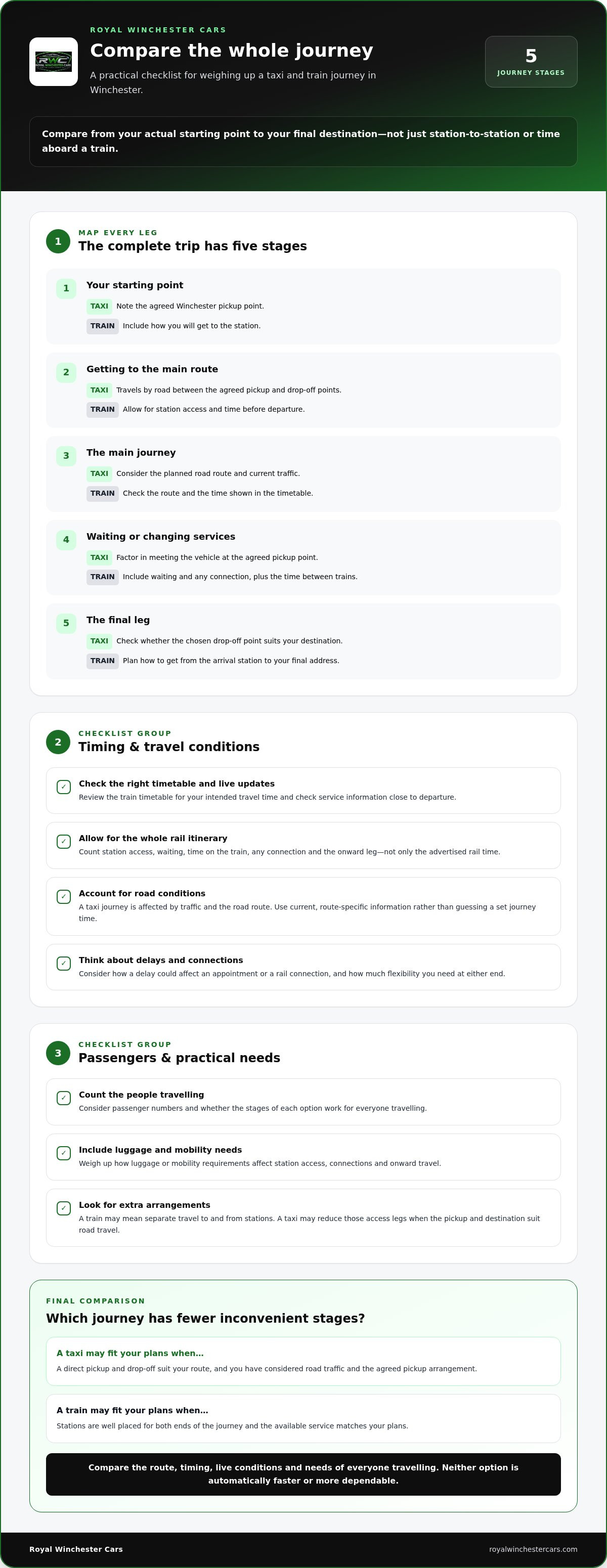
Use this checklist to choose between a taxi and train
Use the same start point, destination and arrival deadline for both options. Then compare the actual journey stages, current travel information and requirements of everyone travelling. This is more useful than comparing a train’s time on the rails with a taxi’s road journey alone.
A five-step transport decision
- Map both endpoints. Write down the exact Winchester pickup point and final destination. For the train option, include how you’ll reach the departure station and continue from the arrival station.
- Check the rail itinerary. Look up current departure times, station access, any changes between services and onward connections. Check service updates before travelling, as changes can affect the plan.
- Assess the road journey. Consider the route and current traffic conditions. Road conditions can affect a taxi journey, just as rail disruption or timetable changes may affect a train itinerary.
- Account for passenger needs. Include the number of people travelling, luggage, mobility requirements and any specific pickup arrangements. Consider each leg, not only the central part of the trip.
- Compare the complete cost and timing. Compare the current quoted taxi fare with the rail fare for everyone travelling, including any separate access or onward travel costs. Add up waiting, station access, connection time and final-leg arrangements when comparing total time.
What details should you settle before travelling?
Start with your required arrival time. Work backwards through each stage and allow time for getting to the station, waiting for a service, making a connection or travelling from the arrival station. For a taxi, account for the road journey and agree the pickup and destination as part of the booking. Avoid relying on a general estimate when live conditions could change your plans.
Before arranging a taxi, have the pickup point, destination, passenger numbers and luggage details ready. If a passenger has specific mobility needs, include those in your planning so the journey arrangements reflect the people travelling. Royal Winchester Cars accepts bookings online or by phone; its Winchester taxi booking options guide outlines both methods.
For rail, check the departure information again before setting out, and make sure you’ve accounted for station access, connections and the onward journey. If the complete comparison points towards a direct road trip, book a Winchester taxi journey with Royal Winchester Cars.
Plan a Winchester taxi journey when it suits your trip
The right choice depends on the complete itinerary, not the transport mode in isolation. If a train timetable, station locations and onward connections fit your plans, rail may be the practical option. If a direct pickup and drop-off better match your route, luggage or access needs, a taxi may simplify the arrangements. For a taxi instead of train Winchester decision, compare both options against the same destination, arrival time and passenger requirements.
Royal Winchester Cars is based in Winchester and provides local and long-distance taxi journeys. Rides are available 24/7, with bookings made online or by phone. This gives you options for arranging a taxi journey when it suits your plans, without assuming a particular pickup time or that a road journey will always be the better fit.
What to prepare for a taxi booking
Before booking, bring the key details together. Have the pickup point, destination and preferred travel time ready, along with the number of passengers and any relevant luggage or accessibility requirements. Clear details help define the journey you need. Royal Winchester Cars offers online and phone booking; the Winchester taxi booking guide explains the booking channels.
For example, a journey involving several passengers and bags may call for different planning from a solo trip with little luggage. Likewise, if a passenger has mobility requirements, include those in your arrangements from the outset. The aim is to make sure the planned journey reflects the people travelling and the actual pickup and drop-off points, rather than relying on assumptions about what will be convenient.
Keep the comparison focused on your actual trip
Before departure, recheck live train information and road conditions. For rail, review the current departure and any service changes that could affect connections. For a taxi, consider road conditions and allow for the journey’s actual route. Compare the taxi quote and rail fare for the same journey and passenger group, including any separate station access or onward travel costs. A fare comparison is only useful if it covers equivalent plans.
Then weigh the complete picture: required arrival time, access at each end, passenger needs, luggage and the number of journey stages. If rail serves your endpoints conveniently and the timetable works, it may be the better fit. If a Winchester taxi suits the route and reduces separate arrangements, Royal Winchester Cars can provide local or long-distance travel. View Royal Winchester Cars’ taxi services when a taxi fits your journey.
Make your next Winchester journey easier to plan
Before you book, decide what matters most for this particular trip. Is arriving by a set time essential? Does the journey need to work around a particular pickup point or passenger requirement? Setting that priority first can make the choice between a taxi instead of train Winchester travel much clearer, especially when both options appear workable on paper.
Keep your travel details together and review them again near departure. Timetables and road conditions can change, so a plan that suited you when you first compared options may need a final check. If a taxi best fits your journey, Royal Winchester Cars is a licensed taxi and private hire operator based in Winchester, with local and long-distance journeys available.
Take the next step at a pace that suits your plans. View Royal Winchester Cars’ taxi services and booking options to consider a road journey for your trip. With the key details in hand, you can make your arrangements with confidence and travel in the way that works best for you.
Frequently Asked Questions
Is a taxi better than a train for travelling around Winchester?
Neither option is better for every Winchester journey. For a taxi instead of train Winchester decision, begin with your exact start and finish points, then consider how station access, the timetable, road conditions and passenger requirements affect the plan. A direct pickup may suit a trip starting away from the station, whilst rail may fit a destination close to a station with a suitable service. Compare the complete journey.
Can I take a taxi to Winchester Railway Station instead of driving?
Yes, a taxi can take you to Winchester Railway Station, so you don’t have to drive your own car there. Allow time for the road journey before your planned train departure, taking your pickup point, traffic and luggage into account. At the other end, consider how you’ll reach your final destination from the arrival station. Check current rail information separately, as schedules and services can change.
How much does a taxi cost compared with a train from Winchester?
The cost depends on your route, the number of passengers, the taxi quote and the rail fares available for your chosen service. Compare like with like: use the same endpoints and passenger group, and include any transport needed to reach or leave the stations. Rail fares can vary by ticket type and travel time. Use a current taxi quote and the applicable rail fare rather than relying on a general estimate.
What happens if my train is delayed or cancelled?
If your train is delayed or cancelled, check the latest service information from the rail operator and review the options for continuing your journey. A taxi may be an alternative if its route and timing suit your needs, but it’s a separate road journey and traffic can affect arrival time. Before changing plans, compare the available options for your actual destination and consider any onward arrangements you’ve already made.
Is a taxi more convenient than the train when travelling with luggage?
It depends on your bags, station access and where you’re going. A taxi may reduce the need to carry luggage between several stages, such as getting to the station and travelling onwards from your arrival point. A train can still suit a route with convenient stations and services. Consider how many people are travelling and what they’ll carry, then include those details when arranging a taxi.
Can I book a wheelchair-accessible taxi in Winchester instead of taking the train?
Yes, Royal Winchester Cars offers wheelchair-accessible taxis in Winchester. Compare the access arrangements needed across the whole trip, including travel to and from stations, boarding and connections, as well as the final leg. Share relevant mobility requirements when booking so the journey can be arranged appropriately. For rail, check current accessibility information for the specific stations and service you plan to use.
Is a taxi or train more reliable for a time-sensitive Winchester journey?
Neither mode is always more reliable; conditions on the route determine how well each fits a time-sensitive plan. Check current rail departure and service updates, and review road conditions for the taxi journey. Allow time for getting to a station, making connections or travelling onwards after arrival. If missing an appointment would cause difficulty, consider which stages have the least flexibility and plan around them.


